Why Penina? Robert Gorjak DipWSET explains Slovenian sparkling wines evolution

2 days ago
8 min read

Robert Gorjak DipWSET is Slovenia's leading wine educator, author and trade professional. As the country's first WSET Diploma holder and founder of Belvin Wine School, he has trained a generation of Slovenian wine professionals since 2002. A judge at Decanter World Wine Awards and contributor to the Oxford Companion to Wine and Hugh Johnson's World Atlas of Wine, Gorjak has contributed to the Slovenian wine sector’s development for over 30 years. Robert kindly shared with us his insights and views on the Penina category's evolutionary change into and a serious, medal-winning sparkling wine movement.
How has the international perception of Slovenian wines changed since you first entered the sector? It would be great to hear your thoughts on the general landscape as well as the specific trajectory of sparkling wines.
I entered the wine sector in 1994 when Slovenia was independent for just 3 years. It was a new country and at the same time an absolute newcomer on the international wine scene. We grew on co-ops (*note by PeninaSlovenia.com - according to the Yugoslavia law only cooperatives could bottle wines and individual producers didn’t have a permission to bottle their own sparkling wine), but then a lot of private producers started producing and bottling their own wines. I believe today we are well known to the professionals in international trade, but still a bit of mystery to the consumers. When they come to Slovenia as tourists, usually they're pleasantly surprised with the quality we reached and the styles we produce here. So we are a nice surprise for people who had no idea, but international trade already knows us as a good quality and great value wine producing country.
Focusing specifically on penina production, how has it evolved during your career? What are the most significant improvements you have witnessed in terms of quality and style?
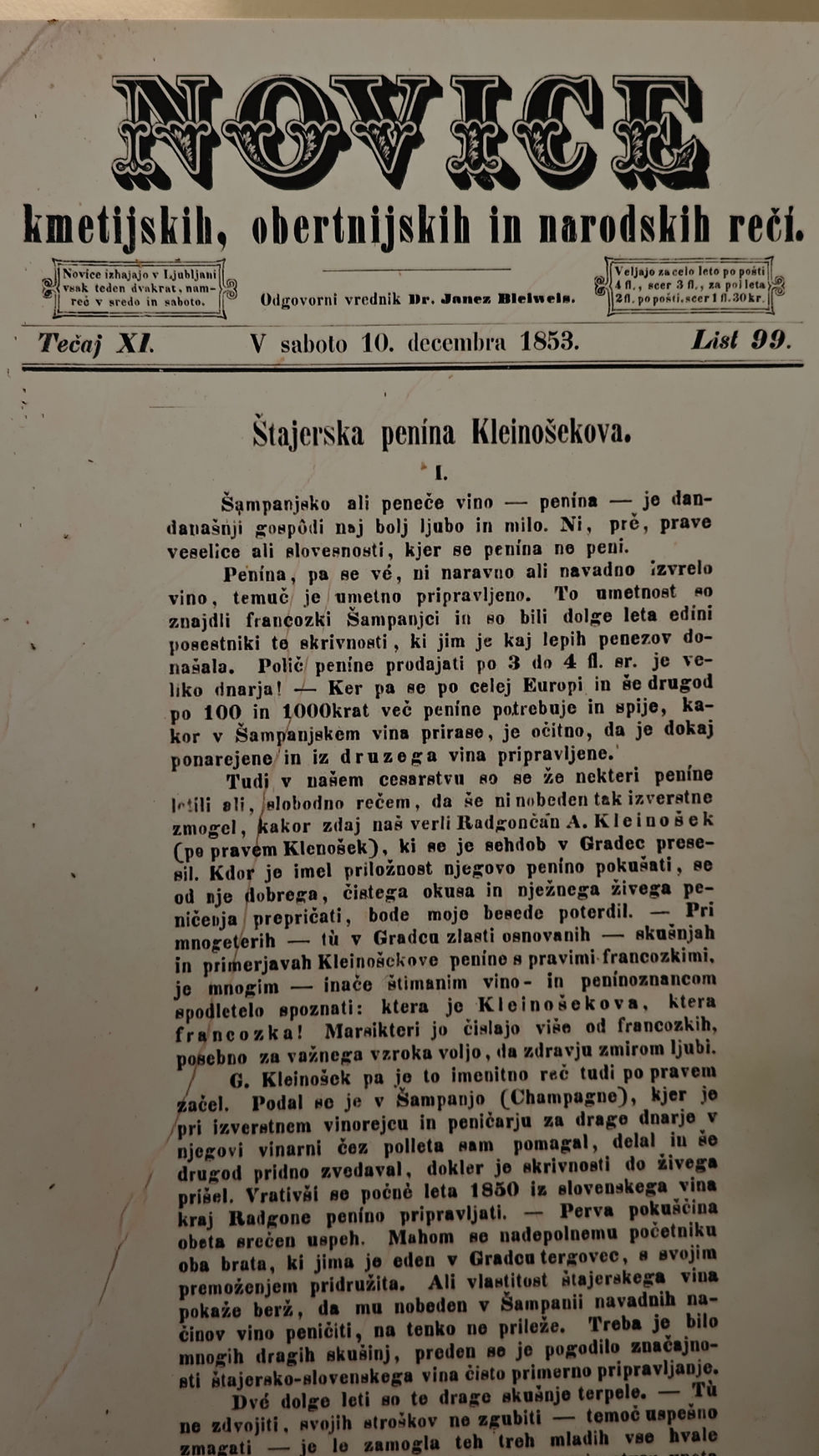
Penina is the category that evolved the most since the mid-nineties. Back then we had only a historical and high volume producer who used a traditional method “Radgonske Gorice” (*note by PeninaSlovenia.com - Established in 1852, it changed many owners since that time, continued production despite everything and recently is the oldest and largest sparkling wine producer in the country). And one more smaller winery - Istenic - among the pioneers of Penina producers since the 60s. And today we have about 200 producers of Penina! A lot of them are boutique, quality oriented and produce a few thousand bottles only. Many of them already achieved impressive results and became really serious producers. Therefore I think that Penina production has really, really evolved. Just looking at the Slovenian medals at Decanter World Wine Awards, we can see how this quality has evolved, how many sparkling wines have received either the gold or even platinum medals.
At the most recent Decanter World Wine Awards 2026, Slovenian winemakers received 186 medals.
Tasting event in Slovenian dedicated to Decanter Awards winning wines, including Penina
Among the award winning wineries we now have some serious producers. A lot of them represent the sub region with the coolest climate Dolenjska: Slapšak, Kozinc, Albiana. Dveri-PAX from Štajerska is getting better and better. Bijana produces more and more impressive wines. Radgonske Gorice is improving their quality every vintage. Puklavec Family Wines produce better and better wines as well. For a long time Medot has been a serious producer with impressive wines. I didn't name all the impressive Penina producers from Slovenia, as we really have a lot. Slovenian sparkling wines evolution goes on and I really enjoy modern Penina. And it has very important advantage as it also offers really great value.
What do you consider the key strengths of the Slovenian penina category today? In your view, what makes it truly distinctive compared to sparkling wines from other countries?
I believe that Penina producers have learned the craft. That every step in the production is important, starting picking the right grapes at the right moment… Actually, Slovenian producers started growing vineyards specifically for the Penina, for the sparkling wine only. They pay attention to the future vineyard location, to the terroir.
While more and more vineyards all over the world are pulled up, Istenič family in 2025 started to prepare the new vineyard for planting. This slop with the East-South orientation is dedicated to vines for sparkling wine production exclusively.
And to production technology as well, as they press whole bunch grapes, age wines on the lees for a long time and so on. Precision and attention to the details really make a difference. Also a nice introduction of some of the local varieties like Rumeni Plavec, Żamenta Crnina… Truly amazing indigenous grape varieties! Penina with Furmint also makes nice wines. I'm personally not so sure about Rebula's potential for sparkling wines, but experiments go on. Chardonnay and Pinot Noir form the important base for the high quality Penina in Slovenia. But then we have these unique additions of indigenous varieties.
Some sub regions also offer a very suitable cool climate like Dolenjska in Posavje. If you add a high altitude, like 500 meters or so, it really contributes to keeping the high level of acidity, therefore perfectly suitable for quality sparkling wines!

If you think that Penia is kind of Slovenian Champagne - you can be disappointed. Never look for Champagne-like style when you drink Penina. Because Slovenian Penina has its own distinctive style. I would say, it is never based completely on the autolytic character. The focus is on purity and precision. This is where Penina really excels.
International wine competitions, such as the Decanter World Wine Awards, serve as vital quality markers. How significant are these results for Slovenian producers seeking to establish themselves in competitive export markets?
I think the Decanter World Wine Awards is a very important competition, because it gives feedback. It shows to the wine producers what kind of wines are high quality and what kind of wines are not. It's not perfect, but it's really good, it shows a really good direction and what is valued in the high-quality sparkling wine world. Therefore it is really interesting how Slovenia has evolved regarding the top medals. The first top medals were for sweet wines. White wines became the next step. Then step number three - sparkling wines. And now step number four is the red wines. Yes, it's really interesting how this has evolved. Competitions like Decanter really help to measure and see the parallel between the quality of Penina in Slovenia and the number of medals at Decanter. So it's very important to follow this.
At the most recent Decanter World Wine Awards 2026, Slovenian winemakers received 5 Platinum, 7 Gold, 60 Silver, and 114 Bronze medals, totaling 186 medals.
For foreign consumers, the term “penina” can be confusing as it covers multiple production methods. Do you believe clearer legal terminology or a more transparent classification system would help international audiences navigate quality tiers more easily?
I think, yes, the clearer terminology can help. Actually, “Penina” is a really nice term, especially if you speak Slavic language and you understand its meaning.(*note - pena or similar words mean foam in several languages: Slovak, Czech, Polish, Slovenian, Serbo-Croatian, Bulgarian, Ukrainian and Russian)
However, the term penina also includes the quality sparkling wines made by Charmat method. Maybe it makes sense to introduce categories like, for example, Reserve, Grand reserve etc. In this case we might add the edge to the term “penina”. But I don't think it's misleading.
The thing is that our biggest penina producer in Slovenia - Radgonske Gorice (*note: producing both - Traditional and Charmat method sparkling wines), will never get rid of this term. As a historical cellar who started penina production in Slovenia, they really want to have it and they will hold it, which is, I think, they have rights to.
But I believe that some extra layers, some quality tiers, a kind of pyramid inside the penina category could really help.

As a wine educator since 2002, you have shaped the knowledge of a whole generation. Have you noticed a shift in how younger professionals and consumers now perceive and approach Slovenian wine and penina in particular?
The greatest shift in what makes a good sommelier or a wine professional is to have a broader perspective, to have knowledge of what is going on in the world, knowing international styles, knowing classic regions, and then in that context, putting Slovenia where it truly fits. This has been the biggest change since I had started, because before that we have been an island on our own. And now the best sommeliers and professionals have gained the knowledge and are able to give a perspective. What are our strengths, how we compare what we do and where we fit in the international wine world. I think this is the biggest shift we have seen.
It might be a difficult choice, but do you have a personal favorite local grape variety for sparkling wine production?

Žametna Črnina is the queen here! No doubt about it. It is capable of maintaining great acidity. You can create different styles with this grape: it can be Blanc de Noir, it can be a really nice Rosé. And it will have a beautiful pale light color! This variety gives good results with autolysis and acidity is really impressive. Žametna Črnina it is...
But Rumeni Plavec is also really good. I also think Furmint aka Šipon is not yet explored as much as it could have been. For now there's only one producer that makes really good 100% Furmint sparkling wine (Dveri-PAX). Furmint can be difficult because it can get that mineral, let's say, quartz kind of taste, which is rather unpleasant in sparkling wines. But when done well, there can be sparkling wines from Furmint without that off flavor. As for Rebula, personally, I'm not that big of a fan of it. I think I've covered these four important local grapes which can add a spice or can be a great, main component of a sparkling wine. But my final answer is Žametna Črnina.
Žametna Črnina is the oldest cultivated grape vine in Slovenian Maribor and at the same time - the most modern discovery of local sparkling winemaking. In recent years this ancestral variety showed an impressive potential for Penina production and became a star of Slovenian sparkling winemaking.
Finally, as not just a wine professional, but a musician with a wide repertoire spanning from rock to jazz: if you had to pair a bottle of penina (perhaps one made from Žametna Črnina) with a song or an album, what would you choose?
I actually think it's more about the mood, not just wine and music. If it's a celebration, then I would play something more close to rock or maybe even disco! Something happy. A happy song from Prince will do! But if I'm more in the meditation mode, I would like to think about something, then I would put on jazz, but more smooth jazz, with not too many solos in it. And, yes, even classical music would do. So I would say, it's more the mood I'm in. And Penina is great stuff anyway! :)
Is there anything else you would like to share with our international audience?
Some of Slovenian Penina is exported, but not too many. When you come to Slovenia - you will find a real treasure here! Penina today offers a really great value. We are filing the niche in between Prosecco and Champagne. Instead of buying Prosecco, here you pay like euro or two more, and you get a seriously good upgrade - Penina from Slovenia. Safe bets! When you order a Penina, you are in very good hands, you will hardly miss. It's actually one of the best categories in Slovenia! So pay attention to it. If you come to Slovenia, don’t miss a chance to try as many Penina wines as possible, and I guarantee you'll be pleasantly surprised.
Thank you very much!
Hvala!