
When does wine become a “style”? The case of Penina

Sep 1
7 min read

Ask ten wine professionals how to define a wine "style" and you will get ten different answers. But there is an agreement on one point: a wine style is not self-evident. It is not created by one bottle or one label. It is created when a number of specific and measurable conditions are met:
✅ A particular production technology
There must be a clearly defined method behind the wine, something specific, intentional and teachable.
✅ Particular flavor and organoleptic characteristics
The wine needs a recognizable sensory identity: a certain kind of mousse, acidity, texture, aromatic profile.
✅ Proven commercial success
A style is not only the wine that is produced, it is what consumers actually enjoy so much that they are willing to pay for it, contributing to the commercial sustainability of this wine. Sales figures and market acceptance show that the wine becomes more than a just wine.
✅ Recognition beyond the producer
The final step is socio cultural. A style becomes real when others name it and talk about it: newspapers, critics, merchants, educated drinkers. This informational field creates a bridge and changes the perception, moving forward from being just wine to becoming a wine style.
Those conditions usually take time to occur and be met properly and in most cases it is hard to name a particular point on the timeline when exactly this transition from a wine to a style has happen. But in case of Penina we have a rare, documented example of all these four conditions appearing together. Let's have a closer look and check if all the conditions are truly met.
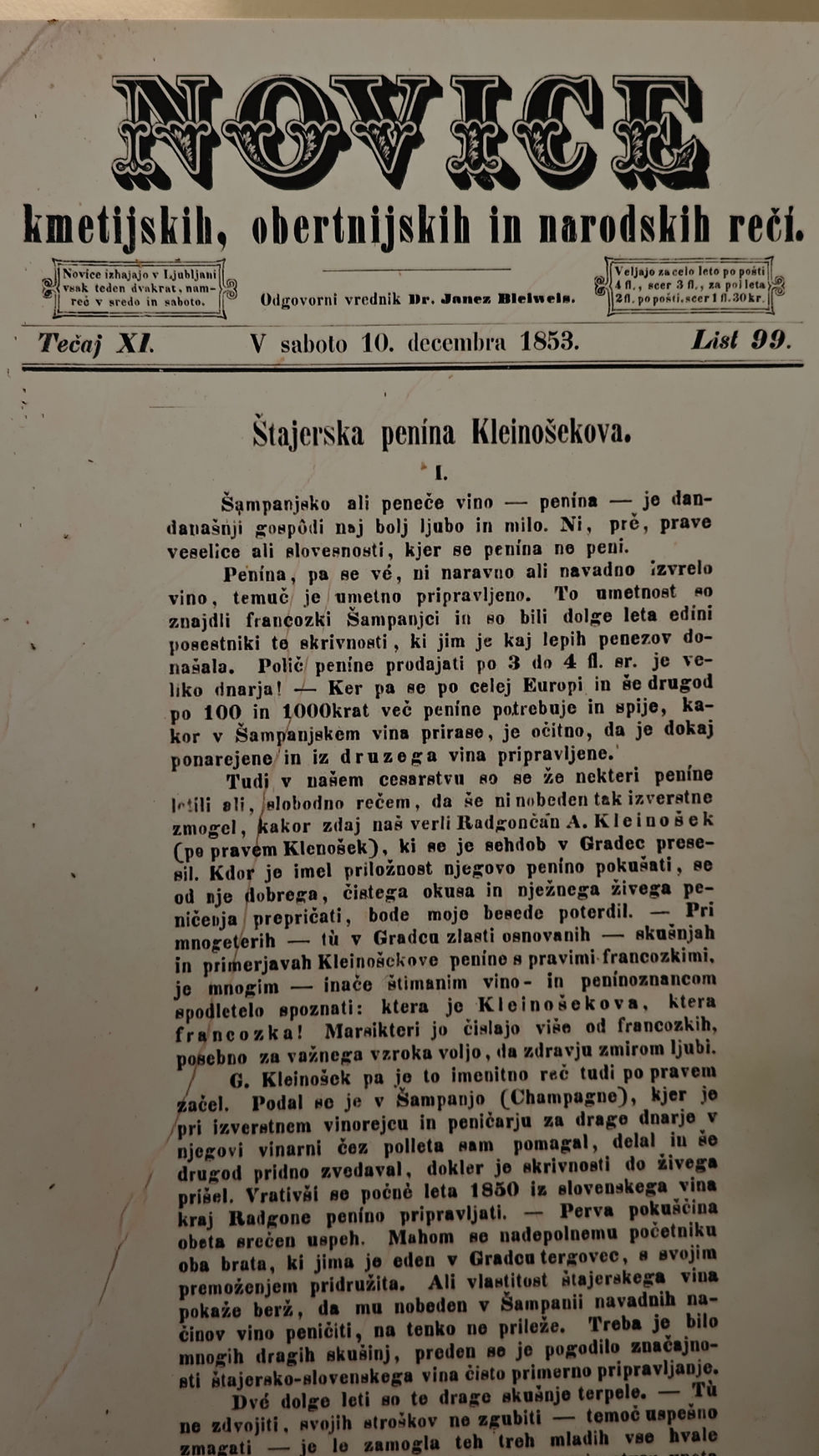
The 1853 newspaper that named Penina for the first time
The first known mention of sparkling wine in the Slovenian region appears on December 10, 1853 in Bleiweis’s Novice (News of Agricultural, Industrial, and National Affairs), edited by Dr. Janez Bleiweis - one of the central public figures of his time.
Here is the full text translation:
“Champagne or sparkling wine - penina - is most dear and beloved by today’s gentlemen. There is no true celebration or ceremony where the penina does not bubble. Penina, as is known, is not naturally or ordinarily fermented wine, but is skillfully/artificially prepared.
This art was discovered by the French Champagne producers, and for many years they were the sole keepers of this secret, which brought them a fair amount of money. Even in our empire, some have already taken up the production of sparkling wine; I can freely say that no one has yet managed to produce it as excellently as our faithful Radgona native Alojz Kleinošek.
Many hold it in higher regard than the French varieties, especially for the important reason that it is always good for one’s health.
Mr. Kleinošek, however, began this noble endeavor in the proper manner. He traveled to Champagne, where, for a high price, he spent half a year working alongside an excellent winemaker and sparkling wine producer in his winery, laboring diligently and studying the craft elsewhere until he had mastered its secrets.
Upon his return, he began producing sparkling wine from Slovenian grapes in the Radgona region in 1850. By the end of 1852, Kleinošek’s successfully produced sparkling wine was already being distributed for sale. It was so well received that within a few months, 12,000 bottles had already been sold.”
Source: Dr. Janez Bleiweis, News of Agricultural, Industrial, and National Affairs, December 10, 1853

If we read this keeping the wine style formation in mind, we can see each of the four conditions for a wine style clearly present.
1. Particular Production Technology: From Champagne to Radgona

The article is emphatic that Penina is not ordinary wine:
“Penina, as is known, is not naturally or ordinarily fermented wine, but is skillfully/artificially prepared.”
In mid‑19th‑century language, “skillfully/artificially prepared” points directly to “secondary fermentation” - what we now call the “traditional method”. The text goes on to trace the origin of the technique:
“This art was discovered by the French Champagne producers…”
And crucially, it documents the transfer of technology to Slovenia:
“He traveled to Champagne, where, for a high price, he spent half a year working alongside an excellent winemaker and sparkling wine producer in his winery, laboring diligently and studying the craft elsewhere until he had mastered its secrets.”

This is a formal apprenticeship in Champagne, followed by deliberate application back home:
“Upon his return, he began producing sparkling wine from Slovenian grapes in the Radgona region in 1850.”
From the very beginning, Penina is tied to a specific, learned method, the same family of techniques that defines Champagne itself. This is the first sign that we are dealing with a genuine style.
Also an important detail that in the case of Penina the wine production starts with traditional method of sparkling wine and later other methods (Charmat method, carbonation) were added. Check! ✅

2. Particular Flavor and Organoleptic Characteristics
There is no surprise that the article emphasizes the mousse. But there is a very important detail: the intentional usage of the local word “penina” which is closely linked to “pena” - foam in many Slavic languages. This tiny linguistic detail shows that this wine became more than a borrowed foreign word, it entered local language and local traditions:
“There is no true celebration or ceremony where the penina does not bubble.”

Penina is the wine that “bubbles” at every true ceremony. This alone would not be enough to define a style, but the article goes further, describing “how people perceive the quality”:
“Many hold it in higher regard than the French varieties…”
This comparison with French Champagne is an early organoleptic judgment. Meaning, consumers have tasted both and many actually prefer Penina. To make such a claim publicly, the writer assumes that his readers know what Champagne tastes like and can imagine the comparison. Penina is not only sparkling; it is sparkling in a way that invites - and withstands - comparison with Champagne.
The mention that it is “always good for one’s health” reflects the thinking of the time, but it also hints at perceived purity and balance. Together, these comments show that at that time this wine already had a recognized and appreciated sensory profile.
We din't get more details about the flavor of Penina from that historical article. But today we can witness how Penina sharpens and develops its unique flavor profile by combining classical grape varieties used for sparkling wine production all over the world with its own “spice” - local indigenous grape varieties.
Also a check! ✅

3. Commercial Success: 12,000 Bottles in a Few Months
Perhaps the most striking line in the entire text is this:
“By the end of 1852, Kleinošek’s successfully produced sparkling wine was already being distributed for sale. It was so well received that within a few months, 12,000 bottles had already been sold.”
In a mid‑19th‑century Central European context, this is an impressive figure. Selling 12,000 bottles of a new, premium, traditionally made sparkling wine in such a short time indicates:

- A functioning distribution network
- A responsive market for quality sparkling wine
- Sufficient production capacity and consistency
- Real consumer trust
Commercial success is one of the clearest signs that a style has formed. The market is saying: we recognize this wine, we value it and we want to have more of it. At that time Penina became already a product with broad acceptance and measurable demand.
So check it is! ✅
4. Recognition by others: media as the final proof
The fourth condition - validation beyond the producer himself - is where this document becomes especially important.
The article is written not by Kleinošek, but by Dr. Janez Bleiweis, a respected public figure. It is published in a widely read newspaper Novice dedicated to agricultural, industrial and national affairs. By choosing to write about Penina, Bleiweis does several things:
- He names the wine style explicitly: “Champagne or sparkling wine - penina…”
- He describes its role in society: “There is no true celebration or ceremony where the penina does not bubble.”
- He reports sales and consumer opinion as factual news: “Many hold it in higher regard than the French varieties… within a few months, 12,000 bottles had already been sold.”
This is exactly the kind of independent testimony that contributs to a style’s existence. The wine is no longer only something made in a cellar; it is something spoken about in public, with a name, a reputation and a place in social life.
Once a wine enters the media in this way, it enters history and becomes a part of the collective memory record and... a wine style! Check as well! ✅
Taken together, these elements show that by the early 1850s (and certainly by December 10, 1853) Penina had moved beyond being just sparkling wine made in Slovenia. It had become a recognized Slovenian sparkling wine style, with a particular production method, taste, appreciators and following media coverage.

Why this matters for Penina today
This historical article is still important today because:
✅ It confirms that the traditional method is not a recent choice, but part of Penina’s original identity
✅ It shows that quality Penina was already considered competitive with Champagne in the 19th century
✅ It demonstrates that the name Penina has always been tied to a specific way of making and experiencing sparkling wine
✅ It underlines the importance of storytelling: without Bleiweis’s article, this moment of style formation might have remained invisible.
Penina is therefore not just “Slovenian sparkling wine.” It is a historically documented wine style, formed when technology, commerce and public voice were blended together. And this blend was so lucky to be recorded right at birth, in 1853. The day, when Penina crossed the line from being just wine and became a particular wine style.


